The Paper: What Was Actually Done
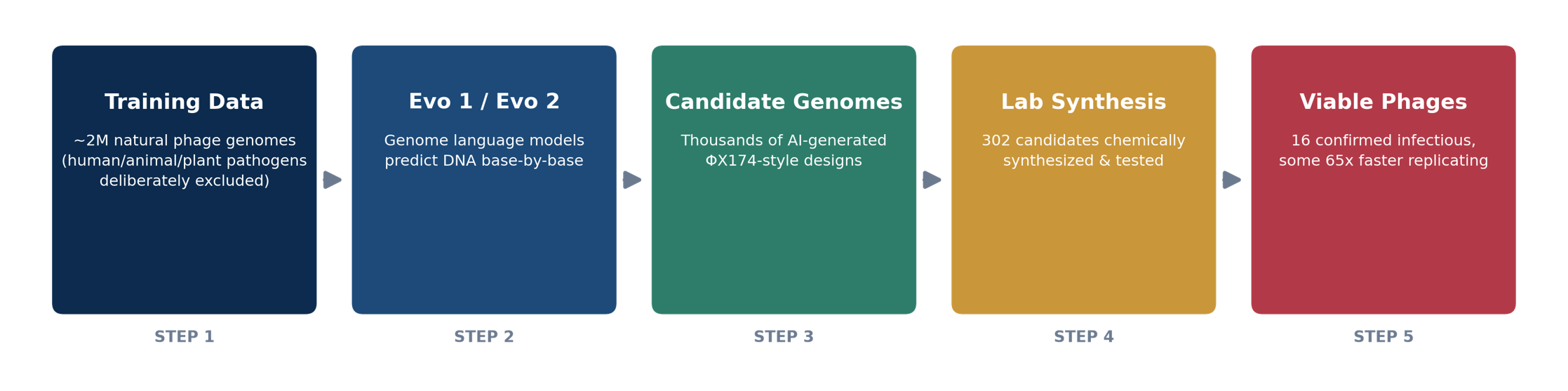
Hie, King, et al., “Generative design of bacteriophages with genome language models,” published in Science recently (August 2026), reported the first peer-reviewed demonstration of generative AI designing complete, functional viral genomes from scratch. A team led by Brian Hie (Stanford) and Samuel King (Stanford bioengineering PhD student), with collaborators from the Arc Institute, NVIDIA, and UC Berkeley, used two “genome language models” namely, Evo 1 and Evo 2, that work like large language models but predict the next DNA base pair instead of the next word.
Method, In Brief
Training data: roughly 2 million natural bacteriophage genomes, with any virus capable of infecting humans, animals, or plants deliberately excluded which was a built-in safety constraint, not an afterthought.
Template: ΦX174, a well-studied bacteriophage that infects E. coli (and the same genome Fred Sanger first sequenced in 1977).
Generation: the models produced complete genomes end-to-end in a single computational pass.
Validation: of the strongest candidates, 302 were chemically synthesized and tested in the lab; 16 assembled into fully viable, infectious bacteriophages.
Results
Two numbers anchor this paper- how often a computational design became a living virus and how these AI-designed viruses performed. Of the 302 candidates synthesized, 16 were confirmed viable phages (5%), and one of the designs carried the function.
Evolution of the Broader Literature
This paper is the leading edge of a fast-moving field, and the broader literature had already anticipated it.
- Evo 1 / Evo 2 themselves (Nguyen et al., Science, 2024) were already notable for generating single genes, CRISPR-Cas systems, and small genomes computationally, but only in silico. This paper is the first time such a model's designs were synthesized, tested, and shown to be alive and functional end-to-end.
- A broader wave of generative biology tools i.e open source, protein-structure and design models such as AlphaFold, RFdiffusion, and ESM has moved AI from predicting biology to designing it.
- The biosecurity community saw this coming. Bloomfieldet al., “AI and biosecurity: the need for governance” (Science, 2024),and Wang et al., “A call for built-in biosecurity safeguards for generative AI tools” (Nature Biotechnology, 2025), both argued one year ahead of this publication that generative genome models would soon produce functional, novel viral genomes, and that safeguards needed to be built into the tools themselves, not bolted on afterward.
- Johns Hopkins Center for Health Security published an accompanying editorial in Science alongside the paper itself: “The ability to compose viral genomes using generative AI now exists; the governance to safely steer it does not.”
Consistent Theme: Governance has not kept pace with the technology developments
Benefits for Medical Science
- There are more than 1M direct antimicrobial resistant (AMR) deaths per year, with 5M associated AMR deaths and the cumulative number between 2025-2030 is projected to be a staggering 39M. The benefits are many:
- A real answer to antimicrobial resistance (AMR). AMR already causes roughly 1 million direct deaths a year with projections of 39 million deaths globally between 2025 and 2050. AI-designed phage cocktails that overcome resistance mechanisms could expand the treatable space.
- Faster, cheaper discovery. Instead of bioprospecting for naturally occurring phages against a specific resistant strain, which can be time consuming and expensive, a generative model can propose thousands of candidates computationally, with only the most promising synthesized and tested. This saves time and cost.
- Personalized, precision phage therapy. Because phages are strain-specific, AI design could eventually support rapidly tailoring a phage cocktail to an individual patient's resistant infection leading to personalized medicine approaches.
- Basic science value. Designs like Evo-Φ36that are functional but evolutionarily distant from anything natural, lets researchers probe regions of sequence space evolution never explored, informing fundamental virology and genome design principles.
Risks
- The screening gap is real and specific. Current DNA synthesis screening is not designed to catch a genuinely novel sequence that could be functionally dangerous.
- Dual-use potential, even in a “safe” demonstration. If “bad actors” were to utilize the technology, then that could be potential dangerous as the paper's guardrails such as excluding human/animal/plant pathogens from training data would not be present.
- Open-source release removes a technical barrier. Evo 2 is openly available. That accelerates legitimate research everywhere, but shifts the practical constraint downstream, to chemical DNA synthesis and lab access still nontrivial, but not impossible for a moderately resourced criminal.
- Unknown unknowns in synthetic organisms. Ecological behavior, off-target effects, and long-term evolutionary trajectory of synthetic organisms released into complex microbial environments aren't fully understood, and evaluation frameworks are immature.
- Decentralization is outpacing governance. Many benchtop DNA synthesizers and smaller or offshore synthesis companies sit outside centralized screening and there is no governance framework.
Ethical Concerns
This is genuinely a case where reasonable, well-informed people land in different places, and the tension is real.
⚠ The case for more caution
The information-hazard question is unresolved; publishingfull method detail and open-sourcing the model is standard science, butmechanically like publishing a capability roadmap. Biology hasn't developed thestaged-disclosure norms of security research use.
⚠ Equity concerns
If phage therapies from this technology reach the clinic, who gets access first? AMR burden falls disproportionately on lower-resource health systems already least likely to benefit early from expensive novel biologics.
What Regulators Should Be Doing
ACTION
- Make nucleic acid synthesis screening mandatory, not voluntary
- Close the oligonucleotide and benchtop-synthesizer gaps
- Fund next-generation, function-based screening
- Update dual-use research review for the AI era
- Harmonize internationally
WHY IT MATTERS
- The current U.S. approach ties compliance to federal funding eligibility rather than imposing a legal requirement on all providers. The pending Biosecurity Modernization and Innovation Act (S. 3741) is the live legislative vehicle for closing this gap.
- Short DNA fragments and smaller or offshore synthesis providers currently fall outside effective screening. Any mandatory framework needs to cover the full supply chain.
- AI-generated sequences may not resemble anything in a known-threat database. Screening needs to evolve beyond similarity search; an active research gap, not a solved problem.
- Existing bodies were built around human-directed gain-of-function research; they need an explicit mandate and technical capacity to review generative-AI-designed constructs specifically.
- A U.S.-only fix is partial in a globalized synthesis and research market and this needs coordination with the EU, UK, and other major biotech hubs, plus WHO-level engagement.
What Industry Should Be Doing
AI Model Developers
- Build safeguards into the model itself, training-data exclusions (as this team did), output-level classifiers, and watermarking of AI-generated sequences so they're identifiable downstream.
- Adopt staged or gated release for the most capable models, with biosecurity risk assessment prior to open release.
- Report capability evaluations transparently, like practices emerging in frontier AI safety more broadly.
DNA/Nucleic-Acid Synthesis Companies
- Adopt and enforce the IGSC Harmonized Screening Protocol industry-wide, including real customer verification (“know your customer”), not just sequence screening.
- Invest in detection methods that flag AI-generated or highly novel sequences even absent a database match, and partner directly with AI developers on shared watermarking and detection standards.
Biotech and Pharma Companies Building on This Technology
- Operate under institutional biosafety committee (IBC) oversight for any generative genome work, with the same rigor applied to gain-of-function-adjacent research historically.
- Engage proactively with FDA and other regulators on what approval pathways for AI-designed or personalized phage therapeutics should look like as these are currently underdeveloped.
- Support, rather than resist, mandatory screening requirements. The credibility of this research area depends on demonstrable, verifiable safety practices; voluntary self-policing has a weak track record under competitive and cost pressure.
THE CORE TENSION
The science is genuinely exciting and the AMR problem it targets is genuinely urgent, but this paper is also a concrete illustration of the tools that have outpaced the governance built to steer them and closing that gap is now the more urgent problem of the two.
* Sikara Consultancy, Evidence Strategy Practice*
\